Event
(Speaker/Panelist) ML Made Simple
Introduction to ML and DL
ML Made Simple
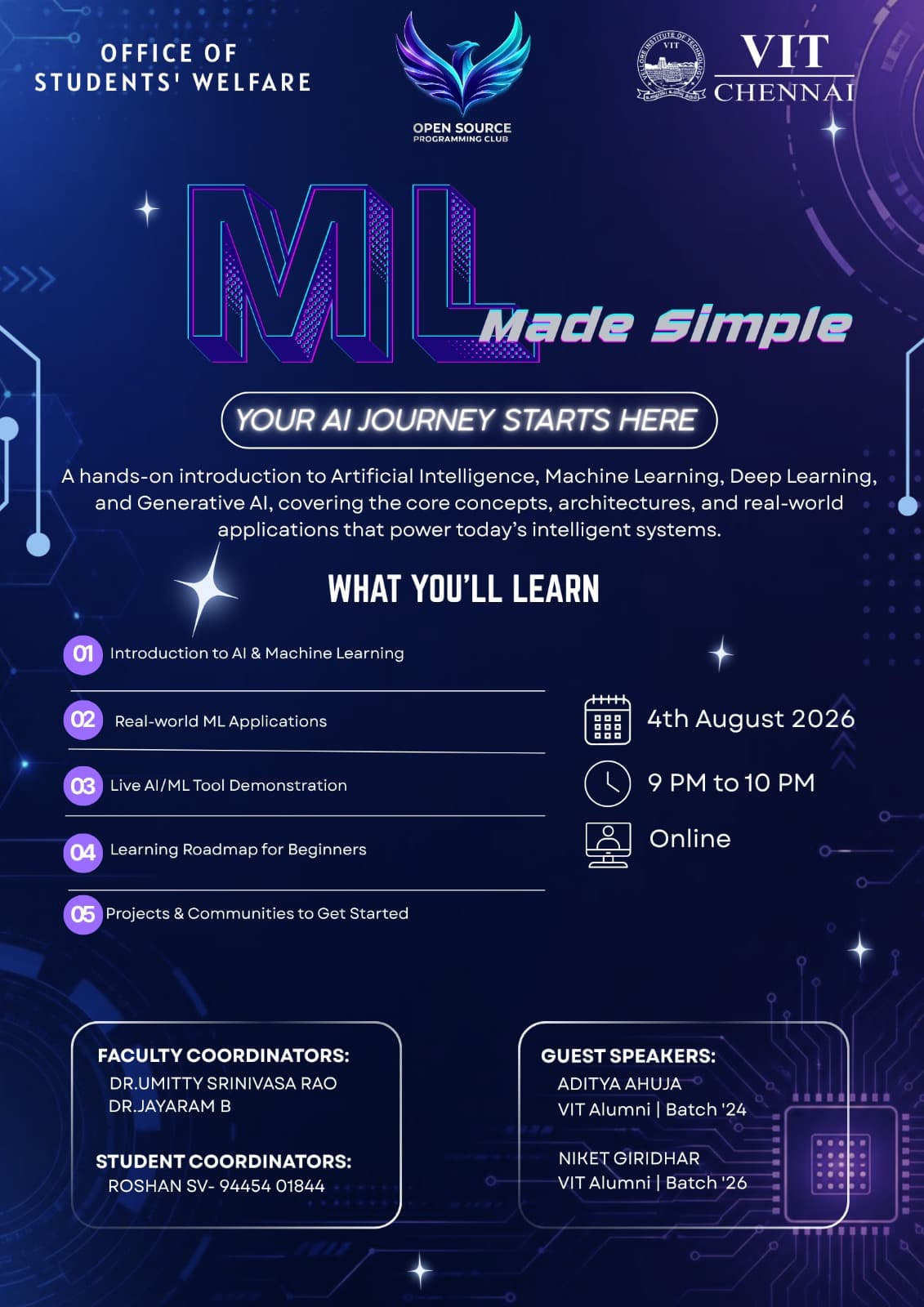
ML Made Simple was an introductory session on Machine Learning, Deep Learning, and Modern AI, organized by the Open Source Programming Club (OSPC), VIT Chennai. The objective of the session was to simplify fundamental AI concepts for students and provide an overview of how modern intelligent systems are built.
Speakers
- Aditya Ahuja (VIT Chennai Alumnus, Batch of 2024)
- Niket Girdhar (VIT Chennai, Batch of 2026) (me)
Session Overview
The session was divided into multiple segments, beginning with the fundamentals of Machine Learning and gradually progressing towards Deep Learning, Large Language Models, Reinforcement Learning, and real-world industrial applications.
Foundations of Machine Learning
Aditya introduced the audience to the intuition behind Machine Learning and explained its primary categories:
- Supervised Learning
- Unsupervised Learning
Within Supervised Learning, he further discussed the difference between:
- Regression
- Classification
using practical examples to help students understand where each approach is applied.
From Machine Learning to Deep Learning
I continued the session by explaining how certain regression problems can be transformed into classification problems before introducing the Machine Learning Complexity Wall.
Using Facial Recognition as an example, I demonstrated why traditional Machine Learning relies heavily on manual feature engineering and how Deep Learning overcomes this limitation by automatically learning features directly from raw data.
To build intuition around neural networks, I connected the concept of Artificial Neurons with Biological Brain Cells, making it easier for students to visualize how information flows through a neural network.
We then explored the evolution of neural network architectures:
- Artificial Neural Networks (ANN)
- Convolutional Neural Networks (CNN)
- Recurrent Neural Networks (RNN) & Long Short-Term Memory (LSTM)
- Transformers
The discussion then moved to Natural Language Processing, where I explained how the same word can have different meanings depending on its context and how modern language models represent words as vectors in high-dimensional embedding spaces.
Modern AI Applications
The final part of my session focused on how Deep Learning powers different categories of AI systems used today:
- Predictive AI
- Diagnostic AI
- Agentic AI
We also discussed why Reinforcement Learning (RL) has become increasingly important in modern AI. Since today's foundation models contain billions to trillions of parameters, repeatedly fine-tuning them for every new task is computationally expensive. Reinforcement Learning enables these models to improve their behaviour through feedback while avoiding repeated large-scale retraining.
Industry Applications
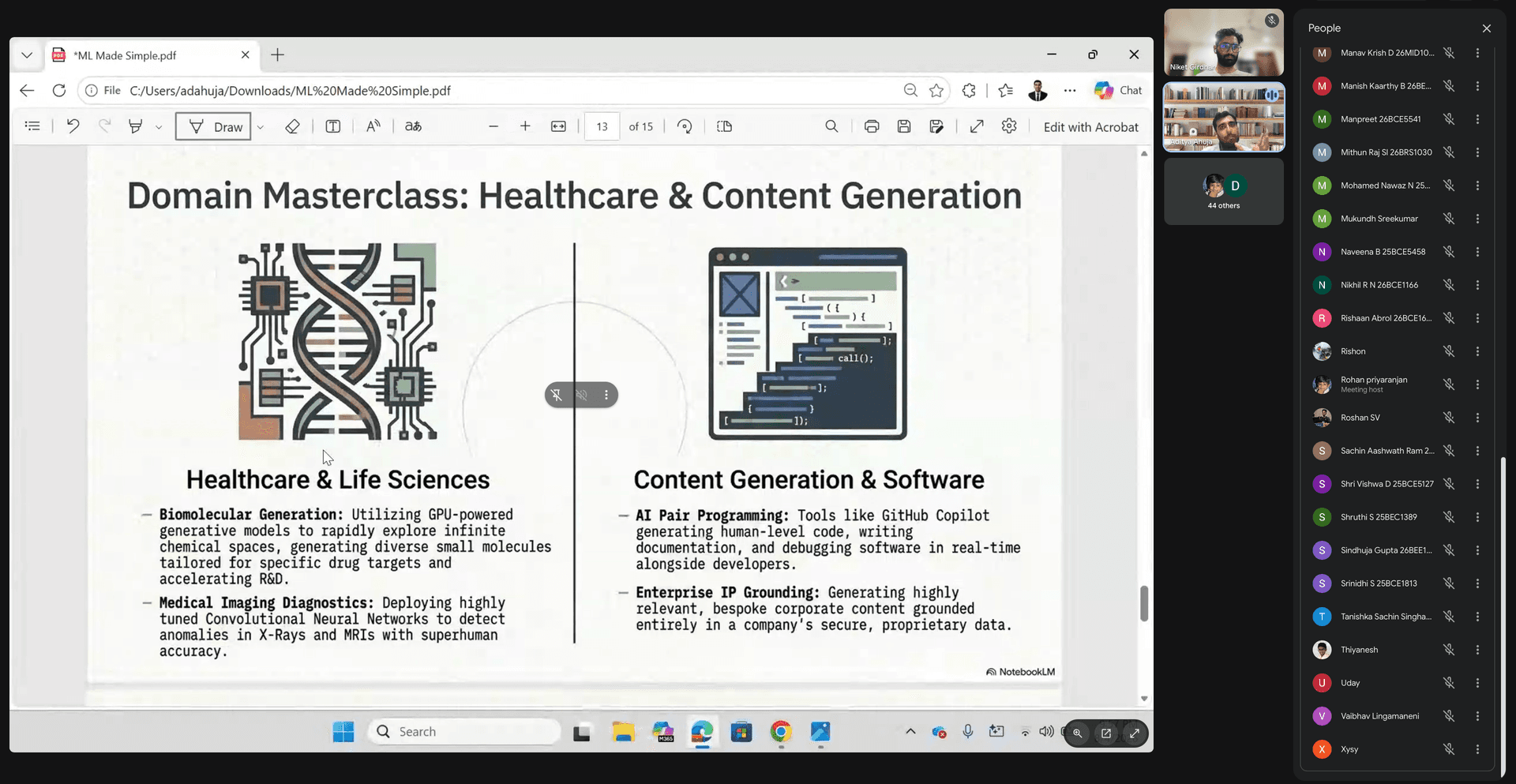
The session concluded with Aditya presenting real-world industrial applications of Machine Learning and Deep Learning across various domains, helping students connect theoretical concepts with technologies currently being deployed in production systems.
Takeaways
The session focused on building intuition rather than mathematics, helping students understand:
- Why Deep Learning became necessary
- How Neural Networks learn from data
- The evolution from ANN to Transformers
- How language models understand context
- Where modern AI systems are used in industry
- Why Reinforcement Learning plays a key role in today's Large Language Models
It was a rewarding experience to share my knowledge with fellow students and contribute towards making AI concepts more approachable for beginners while encouraging them to explore the rapidly evolving field of Artificial Intelligence.
From the event