Post
The 99% Accuracy Trap - Why High Scores Often Signal Failure in Machine Learning
High accuracy can hide overfitting, leakage, imbalance, and shortcut learning. Real ML quality is measured by generalization, robustness, calibration, and business reliability.
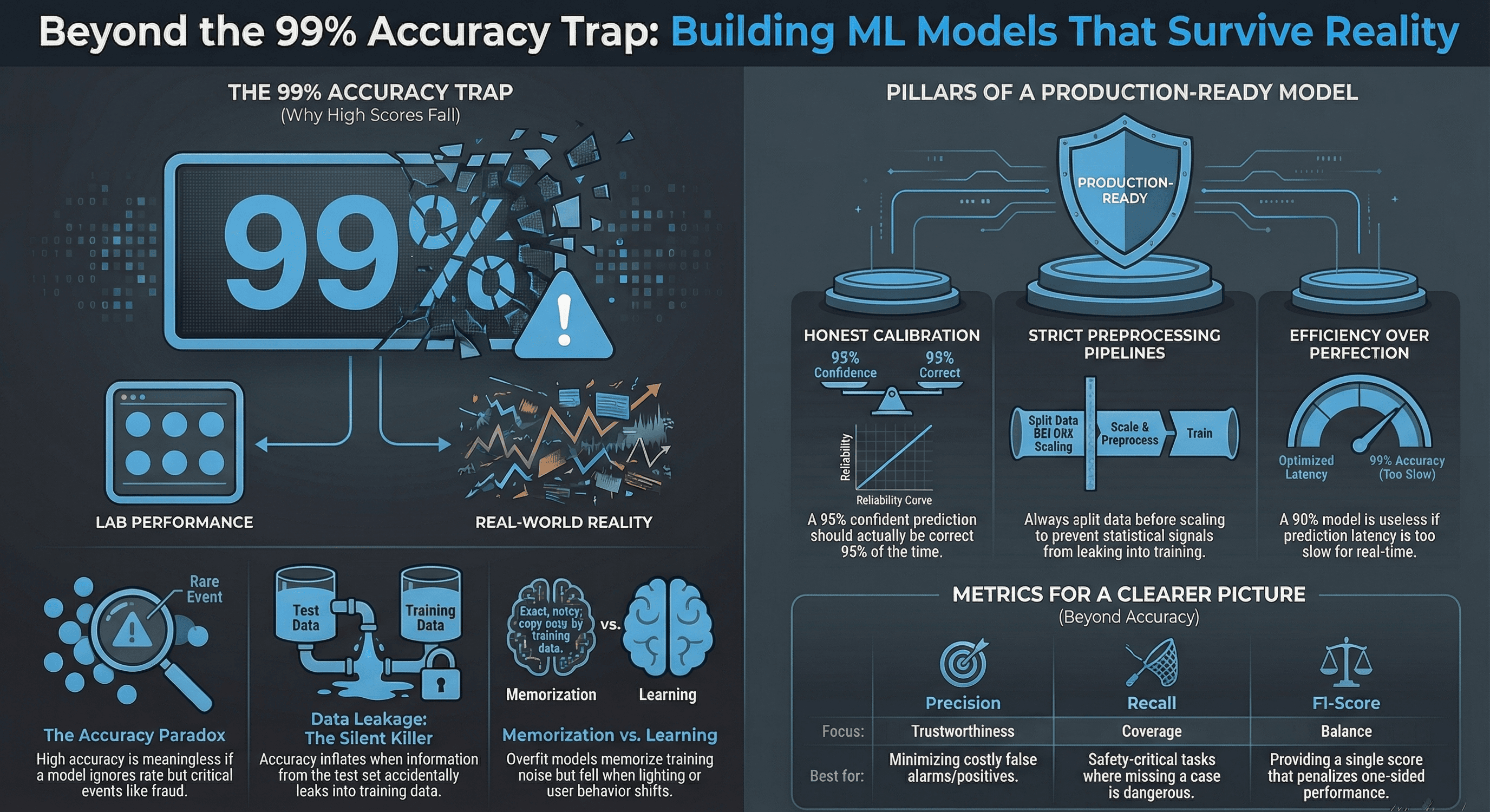
If you're new to machine learning, seeing 99% accuracy feels like you just built something magical.
It looks like your model is perfect.
It feels like you've cracked AI.
But in real-world machine learning, 99% accuracy is often not a victory, it's a warning sign.
Experienced ML engineers don’t celebrate high scores immediately. They get suspicious, because extremely high performance usually means the model has learned shortcuts, memorized the dataset, or the evaluation pipeline is flawed.
This blog explains why high accuracy can be misleading, what typically causes it, and what you should measure instead if you want models that actually survive production.
Why Accuracy is an Unreliable Metric
Accuracy measures the percentage of correct predictions:
- Correct = True Positive + True Negative
- Wrong = False Positive + False Negative
The issue is that accuracy compresses everything into one number. It does not tell you:
- what type of mistakes the model is making
- whether false positives are exploding
- whether the model is missing critical cases
- whether the dataset is imbalanced
- whether the model is overconfident
Accuracy is useful as a quick sanity check, but it is rarely the metric that determines whether a model is production-ready.
The 99% Accuracy Trap
When you see 99% accuracy, there are two possibilities:
- The dataset is genuinely easy and the task is trivial
- Something is wrong in the pipeline or evaluation
Most of the time, it is the second.
A "perfect" score is often a sign that your model is not learning general patterns, but exploiting dataset weaknesses.
1. Overfitting: The Model Memorized Instead of Learning
Overfitting happens when a model performs extremely well on training data but fails on new unseen data.
This is common in deep learning because neural networks have huge capacity. If your dataset is small, the model can easily memorize samples instead of learning generalizable features.
How it looks
- training accuracy approaches 99–100%
- validation accuracy stagnates or drops
- training loss keeps decreasing while validation loss increases
Why it happens
- model too large for the dataset
- weak regularization
- too many epochs
- noisy or biased training data
Why it breaks in production
Real-world data is never identical to your training distribution. There are always shifts:
- different lighting (vision)
- different microphones (audio)
- different environments
- new users and behaviors
- sensor drift
A memorized model collapses as soon as conditions change.
Fixes
- early stopping
- dropout
- weight decay
- smaller models
- data augmentation
- cross-validation
- collecting more data
2. Training Too Long: Learning Noise Instead of Signal
Even if your model starts learning meaningful patterns early, training for too many epochs can push it into a noise-learning phase.
At that point, the model begins fitting:
- random variations
- dataset quirks
- artifacts that do not exist in real data
This inflates accuracy on the dataset, but destroys real-world generalization.
Fix
- monitor validation loss
- stop training when validation loss stops improving
- use early stopping callbacks
- use learning rate scheduling
3. Small Dataset: High Accuracy is Easy to Fake
If your dataset is small, high accuracy is not impressive.
Deep learning models have millions of parameters. If you have only a few hundred or thousand samples, your model can memorize the entire dataset.
This is especially common in beginner projects where people train large CNNs on tiny datasets and get near-perfect accuracy.
Fixes
- transfer learning (freeze backbone layers)
- heavy augmentation
- K-fold cross validation
- collecting more diverse data
- using a smaller architecture
4. Evaluating on Training Data: The Beginner’s Trap
Sometimes the 99% accuracy is not even a modeling problem, it's simply evaluation done wrong.
Testing on training data is like practicing 100 questions and then writing the exam with the exact same questions.
The model is not learning intelligence. It is repeating memory.
Common reasons this happens
- mixing train and test folders accidentally
- using training generator for evaluation
- incorrect dataset split logic
- overwriting variables
Fix
Always maintain a strict split:
- training set: learns parameters
- validation set: tuning and model selection
- test set: final locked evaluation
If the test set is not locked, your results cannot be trusted.
5. Data Leakage: The Silent Killer of ML Projects
Data leakage is one of the most dangerous problems in machine learning.
It happens when information from the test set accidentally influences training.
This creates artificially inflated scores that look real, but collapse in production.
Engineers call leakage the "silent killer" because it is easy to miss and hard to detect until deployment.
Common Ways Data Leakage Happens
5.1 Preprocessing Before Splitting
A classic leakage mistake is scaling or normalizing the entire dataset before splitting.
If you compute dataset statistics globally, you leak the test distribution into training.
Correct rule:
Split first, preprocess later.
5.2 Duplicate Samples in Train and Test
If the same image, audio clip, or record exists in both train and test sets, your evaluation becomes meaningless.
This happens frequently in scraped datasets or datasets with repeated frames.
Fix
- check duplicates using hashes
- group samples by unique ID
- remove repeated records
5.3 Patient/User Leakage (Entity Overlap)
In medical or user-based datasets, a single patient may have multiple records.
If the same patient appears in both train and test sets, the model learns to recognize the person instead of learning the disease.
This can create extremely high accuracy that does not generalize to new patients.
Fix
Use group-based splitting:
- GroupKFold
- patient-level splits
- user-level splits
5.4 Time-Series Leakage
In time-series datasets, random splitting is a serious mistake.
If training contains future data relative to the test set, the model is effectively cheating.
Fix
Always split chronologically.
5.5 Feature Selection Leakage
Feature selection can leak test information if it is performed on the full dataset.
If you select features using all labels, the model indirectly learns about test targets.
Fix
Feature selection must be done only on training folds.
6. Class Imbalance: High Accuracy Can Be Meaningless
Accuracy becomes dangerous when one class dominates the dataset.
Example:
- 95% "No Fraud"
- 5% "Fraud"
A model that always predicts "No Fraud" gets 95% accuracy.
But it catches zero fraud cases.
This is known as the accuracy paradox.
The model looks good on paper but is useless in practice.
Fix
Use metrics that focus on minority class performance.
7. Shortcut Learning: When the Model Learns the Wrong Thing
Deep learning models do not learn what you want them to learn.
They learn what is easiest.
If there is a shortcut signal in the dataset, the model will exploit it.
Examples:
- hospital watermark in pneumonia X-rays
- background color differences in classification images
- microphone noise differences in audio datasets
- camera resolution artifacts
Shortcut learning is one of the biggest reasons high-accuracy models fail in production.
Fix
- inspect data manually
- use adversarial testing
- validate on external datasets
- run bias analysis
What a Good Model Should Have Instead of High Accuracy
A production-quality model is defined by reliability, not a high score.
Here are the core pillars that matter.
1. Generalization
A good model performs well on unseen data and maintains stability across different distributions.
You want:
- low train-test gap
- consistent validation results
- strong cross-validation performance
2. Robustness
A good model should not collapse under small input changes.
It should survive:
- noise
- missing values
- slight distortions
- distribution shifts
Robustness is a key requirement for real-world deployment.
3. Calibration (Honest Confidence)
A model’s confidence score must be meaningful.
If it predicts something with high confidence, it should actually be correct most of the time.
Uncalibrated models are dangerous because they can be confidently wrong.
Calibration is critical in:
- healthcare
- finance
- cybersecurity
- autonomous systems
4. Stability Across Runs
If the model’s performance changes drastically across random seeds, it is unreliable.
A good model should be stable across:
- retraining
- resampling
- different splits
5. Efficiency and Deployability
A model is not good if it cannot run under production constraints.
A practical model must consider:
- inference speed
- memory usage
- cost per prediction
- hardware constraints
A slightly less accurate model that is 10x faster is often the better choice.
Metrics That Matter More Than Accuracy
Accuracy is not useless, but it is rarely enough.
Production ML focuses on:
Precision
Useful when false positives are expensive.
Recall
Useful when false negatives are dangerous.
F1-score
Balanced metric when both matter.
Confusion Matrix
Shows exact failure patterns.
ROC-AUC and PR-AUC
Measures ranking quality across thresholds.
Log Loss
Penalizes confident wrong predictions.
A Production Checklist to Avoid the 99% Trap
Before trusting your model, ask:
- Did I split the dataset correctly?
- Did I preprocess after splitting?
- Did I avoid duplicates?
- Did I prevent patient/user overlap?
- Did I test on real-world samples?
- Did I use correct metrics beyond accuracy?
- Did I evaluate calibration and robustness?
If you cannot answer yes to these, your 99% score is meaningless.
Final Takeaway
High accuracy feels like success, but in machine learning it often signals the opposite.
99% accuracy can mean:
- your model memorized the dataset
- your dataset is biased or too easy
- your evaluation pipeline is broken
- your test set leaked into training
- your model is exploiting shortcuts
A truly good model is not defined by how well it performs on a static test set.
It is defined by how well it performs when reality changes.
Because the real goal of machine learning is not to win accuracy.