Post
RedSage - Building a Cybersecurity Generalist LLM with Agentic Data Augmentation
Tiny Recursive Models prove that thinking longer through recursion can outperform thinking bigger through scale in AI reasoning.
Large Language Models have shown impressive general reasoning abilities, but cybersecurity exposes their weakest points:
- incorrect command syntax
- hallucinated tools
- shallow understanding of real-world workflows
RedSage addresses this gap by asking a different question:
How do we teach an LLM to think like a security practitioner, without turning it into a narrow specialist?
The answer lies in a data-centric, agentic training pipeline that bridges general knowledge and domain expertise.
The Core Problem: General vs Domain-Specific Models
Traditional approaches fall into two categories:
- General-Purpose LLMs
- Strong reasoning and language skills
- Weak at:
- tool usage
- vulnerability workflows
- framework grounding (MITRE, OWASP, NIST)
- Security-Specialized Models
- Memorize terminology and benchmarks
- Often suffer from:
- catastrophic forgetting
- degraded math and reasoning
- brittle performance outside cybersecurity
RedSage aims to combine both.
RedSage Architecture Overview
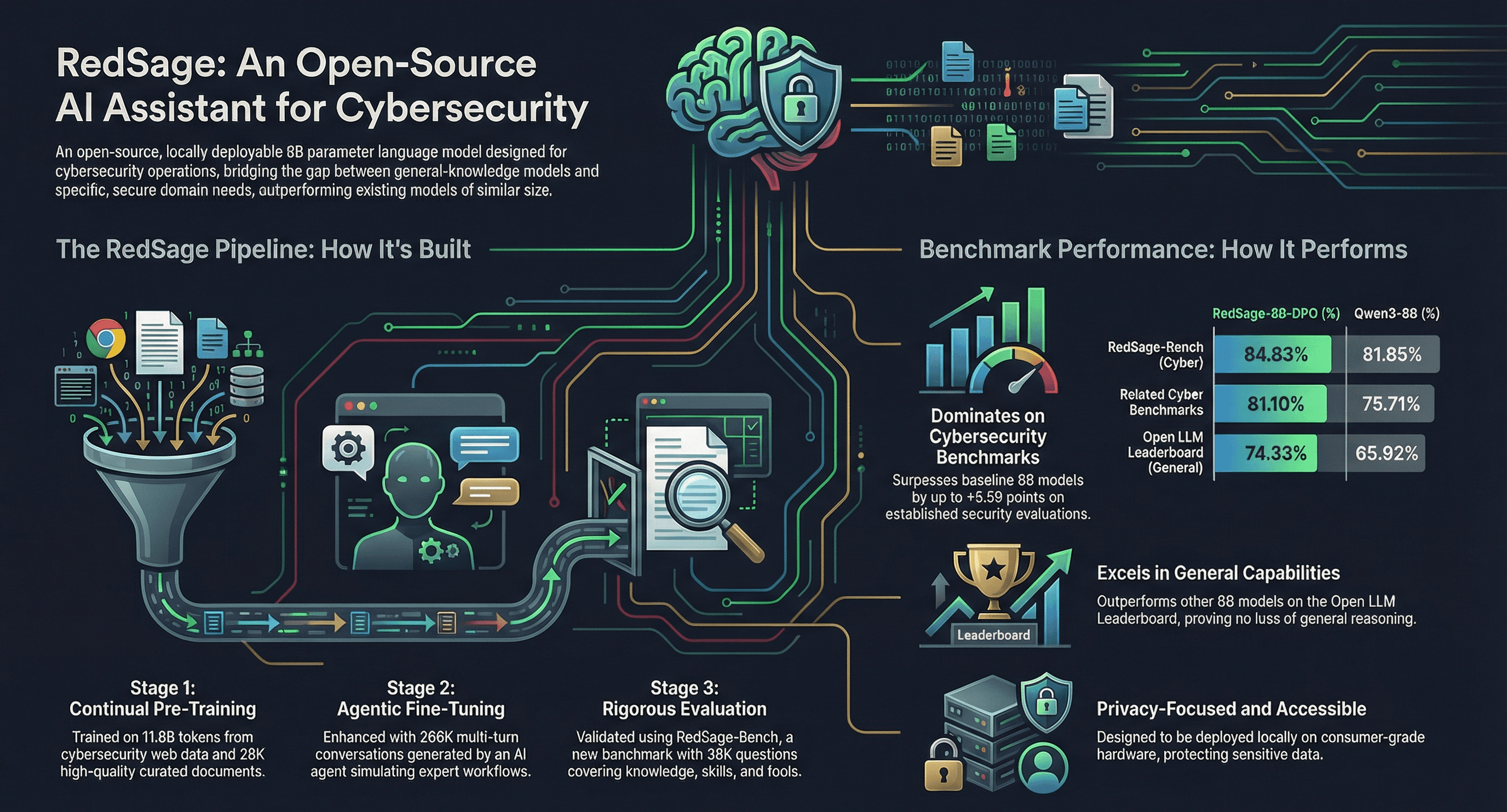
RedSage is an 8B-parameter, open-source, locally deployable LLM, designed for privacy-sensitive security environments.
Its training pipeline consists of three tightly coupled stages:
- Continual Pre-Training
- Agentic Fine-Tuning
- Rigorous Multi-Axis Evaluation
Stage 1: Data-Centric Continual Pre-Training
CyberFineWeb: Domain Filtering at Scale
RedSage introduces CyberFineWeb, a 11.7B-token cybersecurity corpus built by:
- Filtering FineWeb using a BERT-based cybersecurity classifier
- Retaining both theoretical and operational content Preventing Catastrophic Forgetting
Instead of training purely on security data, RedSage uses controlled replay:
- ~30% general-knowledge replay via FineWeb-Edu
- Maintains broad reasoning, math, and instruction-following skills High-Trust Seed Data
The model also ingests:
- MITRE ATT&CK
- OWASP documentation
- NIST standards
- Offensive security write-ups
This RedSage-Seed dataset turns out to be surprisingly important, not just for security, but also for math reasoning.
Stage 2: Agentic Data Augmentation (The Key Innovation)
The most novel part of RedSage is its agentic augmentation pipeline.
Why Static Docs Aren’t Enough
Most cybersecurity knowledge exists as:
- manuals
- reports
- PDFs
- blog posts
But real security work is conversational and procedural:
- multi-step reasoning
- tool chaining
- role-based collaboration
Planner + Augmenter Agents RedSage converts static text into workflows using two agents:
- Planner Agent
- Analyzes seed documents
- Extracts implicit skills
- Proposes multiple augmentation strategies:
- exploitation walkthroughs
- threat mapping
- SOC troubleshooting
- tool command generation
- Augmenter Agent
- Executes the plan
- Generates multi-turn, role-based dialogues
- Grounded strictly in the source material
- Preserves:
- exact commands
- flags
- vulnerability identifiers
Scaling effect
- ~28K documents → 266K conversations
- 9.2× sample expansion
- 2.3× token growth
- Average ~10 turns per dialogue
This solves the human labeling bottleneck in cybersecurity.
Tool-Specific Performance: Why RedSage Excels
Most LLMs fail when precision matters.
RedSage doesn’t.
Because it trains on workflow-level conversations, it learns:
- exact CLI syntax
- correct sequencing of actions
- framework-aligned reasoning
Qualitative evaluations show:
- Correct command construction where others hallucinate flags
- Accurate threat actor attribution
- Better grounding in real tools and procedures
Stage 3: Evaluation Without Blind Spots
RedSage is evaluated across:
- RedSage-Bench (knowledge, skills, tools)
- External security benchmarks
- Open LLM Leaderboard (general reasoning)
Results Snapshot
- +5.5 points over 8B baselines on cybersecurity benchmarks
- Near-parity with much larger models on security tasks
- Improved general reasoning, not degraded
This confirms the central claim:
Specialization does not require sacrificing general intelligence.
Why This Matters
RedSage demonstrates a broader lesson for applied AI:
- Data strategy > model size
- Agentic pipelines > static supervision
- Workflows > isolated Q&A
For security teams, this means:
- privacy-preserving local deployment
- models that understand real tools
- assistants that behave like junior analysts—not encyclopedias
Final Takeaway
RedSage is not just a cybersecurity LLM. It’s a template for domain adaptation done right.
If you’re building:
- domain-specific assistants
- agentic training pipelines
- AI systems for high-precision tasks
RedSage is worth studying closely.
Paper link: