Post
Tiny Recursive Models - Why Recursion Beats Scale in AI Reasoning
Tiny Recursive Models prove that thinking longer through recursion can outperform thinking bigger through scale in AI reasoning.
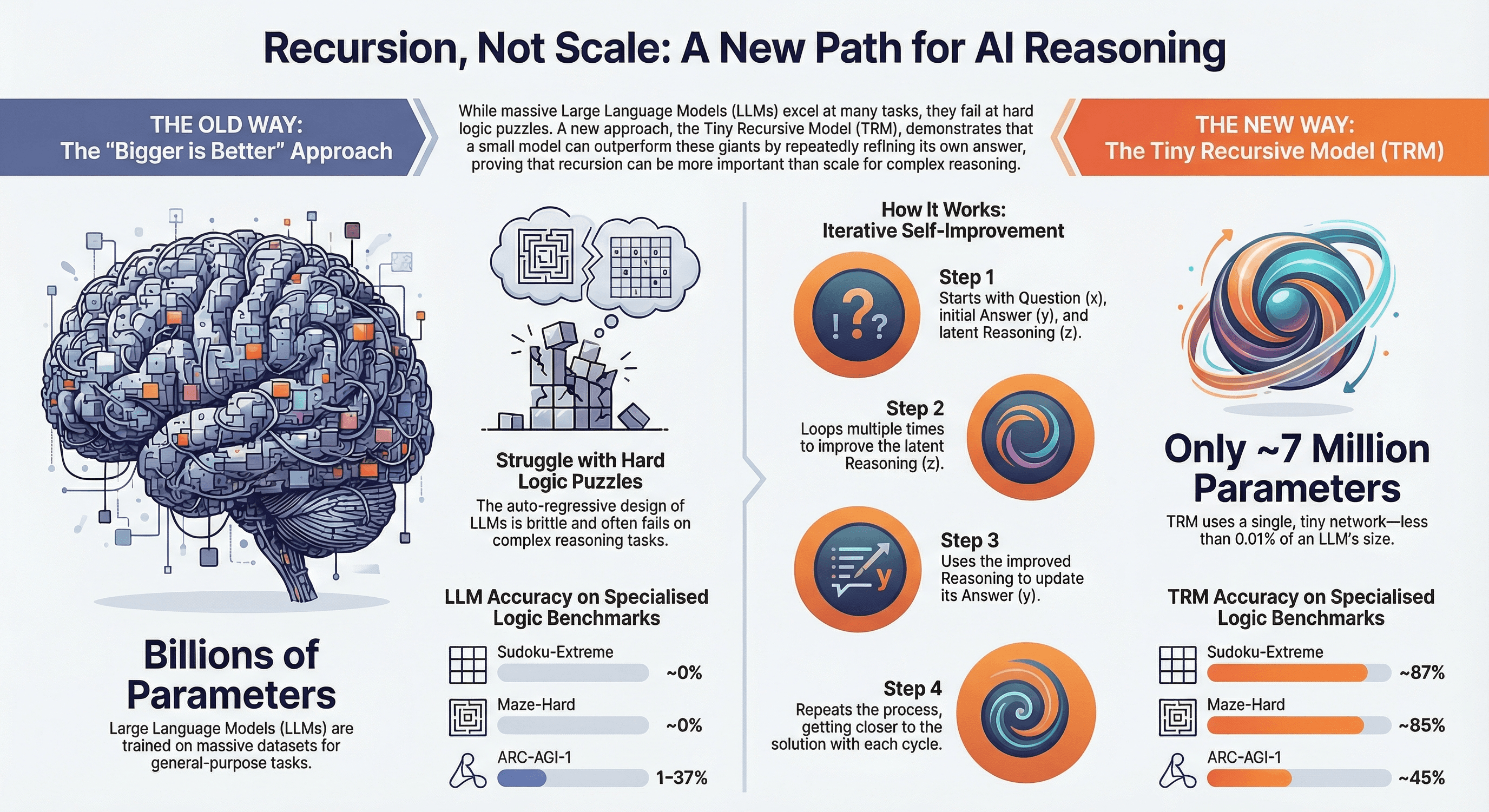
For the last decade, progress in artificial intelligence has been driven by a single dominant idea: scaling. Bigger datasets, larger models, deeper networks, and more compute have consistently produced better results across language, vision, and multimodal tasks.
However, when it comes to hard reasoning problems: Sudoku, mazes, symbolic transformations, and ARC-AGI-style puzzles, this scaling strategy begins to break down.
A recent paper from Samsung SAIL Montréal introduces the Tiny Recursive Model (TRM), a system with only ~7 million parameters that outperforms much larger models on several logic benchmarks. Instead of relying on scale, TRM relies on recursion and iterative refinement.
This post explains how TRM works, why it succeeds where large language models fail, and what it teaches us about the future of reasoning-centric AI.
The Fundamental Weakness of Large Language Models
Large Language Models (LLMs) generate outputs auto-regressively: one token at a time, left to right. This works extremely well for natural language, but it is poorly suited for problems that require global consistency.
Consider a Sudoku puzzle.
A single incorrect digit violates constraints across rows, columns, and sub-grids. In an auto-regressive setup:
- Early mistakes cannot be revised
- Errors propagate irreversibly
- The model has no mechanism to “rethink” previous steps
This is why many state-of-the-art LLMs achieve near-zero accuracy on Sudoku-Extreme or Maze-Hard, despite having billions of parameters.
The problem is not a lack of intelligence, it is a lack of iterative reasoning.
From One-Shot Prediction to Recursive Reasoning
The core idea behind TRM is simple but powerful:
Reasoning should be a process, not a single forward pass.
Instead of predicting an answer once, TRM loops over the same network multiple times, refining its internal state and output at each iteration.
This turns reasoning into a dynamical system rather than a static mapping.
The TRM State Representation
At every iteration, the model operates on three components:
- x: the input problem (e.g., a Sudoku grid or ARC task)
- yₜ: the current predicted solution
- zₜ: a latent reasoning state
The model learns a function:
(zₜ₊₁, yₜ₊₁) = f(x, zₜ, yₜ)Here:
- z acts as a continuous, vector-based “chain of thought”
- y stores the current best solution
- The same function f is reused at every step
This reuse is crucial. Instead of adding depth through more layers, TRM adds depth through time.
Simulated Depth Through Recursion
Although TRM uses only a 2-layer network, recursion gives it an effective depth of ~40+ layers.
This happens because:
- Each iteration composes the same transformation again
- Gradients flow through the entire unrolled recursion during training
- The model learns how to update its own reasoning state
In practice, this behaves like a deep network, but without the parameter overhead.
This concept is sometimes called time-unrolled depth, and it is central to TRM’s success.
Deep Supervision: Training the Model to Improve Itself
One of the most important techniques used in TRM is deep supervision.
Instead of supervising only the final output:
- The model is trained to produce better answers at every iteration
- Loss is applied across multiple refinement steps
This teaches the network a skill that standard models never learn:
How to improve a partially wrong solution.
As a result:
- Early iterations produce rough guesses
- Later iterations progressively correct errors
- The model learns how to reason, not just what the answer looks like
Why Smaller Models Generalize Better Here
TRM’s parameter count (~5–7M) is not a limitation, it is an advantage.
Logic benchmarks typically have:
- Very small datasets (often ~1,000 examples)
- Strong structural rules
- Minimal tolerance for memorization
Large models tend to overfit in this regime. TRM avoids this by:
- Limiting representational capacity
- Forcing reuse of the same reasoning function
- Treating recursion depth as compute, not parameters In ablation studies, increasing the number of layers reduced performance, confirming that minimalism improves generalization for these tasks.
Architectural Simplification from HRM to TRM
TRM is derived from the earlier Hierarchical Reasoning Model (HRM), but it removes much of HRM’s complexity:
- Two networks → one network
- Hierarchical latent states → functional (z, y) states
- Fixed-point assumptions → full backpropagation through recursion
- Complex halting losses → a single learned halting mechanism
This simplification made the model:
- Easier to train
- More stable
- More interpretable
- More effective
In other words, less theory, better results.
Attention Is Optional (and Sometimes Harmful)
TRM also challenges another assumption: that self-attention is always necessary.
For fixed-structure tasks like Sudoku:
- Replacing attention with a simple MLP improved generalization
- Removing attention reduced overcapacity
However, for tasks like ARC-AGI:
- Spatial relationships matter
- Self-attention remains essential
This shows that architecture should match task structure, not default to general-purpose components.
Stability Through Exponential Moving Average (EMA)
Training recursive systems can be unstable. TRM addresses this using:
- Exponential Moving Average (EMA) of weights
EMA smooths parameter updates and:
- Prevents divergence
- Improves convergence
- Increases final accuracy significantly
This is especially important when training with small datasets and deep recursion.
Why TRM Outperforms Massive Models
Putting everything together, TRM succeeds because it replaces:
- Scale → Iteration
- One-shot prediction → Self-correction
- Text-based reasoning → Latent vector reasoning
- Model depth → Time-unrolled depth
Instead of guessing harder, the model thinks longer.
Implications for the Future of AI Reasoning
TRM demonstrates that:
- Reasoning does not require billions of parameters
- Iterative refinement is a powerful inductive bias
- Small models can outperform large ones on the right problems
This has major implications for:
- Edge and low-compute AI
- Formal reasoning systems
- Hybrid neuro-symbolic models
- The future of ARC-style benchmarks
The scaling era is not over, but TRM shows that scaling is not the only path forward.
Final Takeaway
Tiny Recursive Models do not aim to replace large language models.
They expose something deeper:
Intelligence is not just about knowing more, It is about revising what you know.
And recursion may be the most efficient way to do exactly that.
Paper link: