Post
dataRLsec - Safety, Security, and Reliability With Robust Offline Reinforcement Learning for DPAs
Junk data and data poisoning both corrupt AI at training time by distorting learned representations, and robust offline reinforcement learning defends against this by identifying and down-weighting untrustworthy data before it can damage reasoning and behavior.
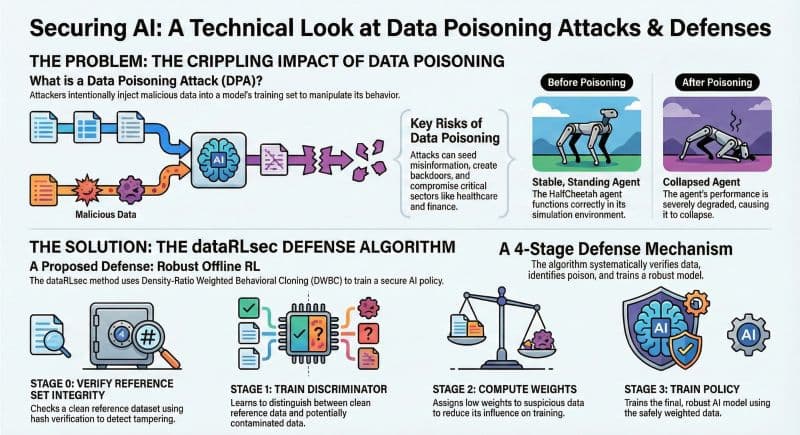
Robust Offline Reinforcement Learning, Data Poisoning, and the “Brain Rot” Problem
1. Why this problem matters
Modern AI systems learn almost everything from data. This sounds obvious, but it hides a serious risk: models trust their training data completely. If that data is bad, whether intentionally or accidentally, the model’s internal reasoning and behavior degrade in ways that are often hard to reverse.
Two recent research directions expose this clearly:
- Data poisoning attacks, where adversaries deliberately inject malicious data.
- LLM Brain Rot, where large language models degrade simply by consuming massive amounts of low-quality, engagement-driven internet text.
Although these look like different problems, they share a common root: distributional corruption during training.
2. What is data poisoning?
Data poisoning is a training-time attack. Instead of hacking the model directly, an attacker manipulates the data the model learns from.
Common examples:
- Subtly changing inputs so the model learns the wrong patterns
- Adding hidden “triggers” that cause malicious behavior later
- Shifting decision boundaries without changing labels (clean - label attacks)
The dangerous part is that the model often looks normal during testing but fails under specific conditions.
3. How is “junk data” different from poisoning?
The LLM Brain Rot Hypothesis shows that no attacker is required.
Here, the model is harmed by:
- Very short text
- Highly popular, viral content
- Sensationalist or shallow writing styles
This data is not malicious. It is simply optimized for engagement, not thinking. Over time, models trained on large volumes of this content begin to:
- Skip reasoning steps
- Struggle with long contexts
- Exhibit unstable or hostile behavioral traits
This is why the paper reframes junk data as a training-time safety issue, not just a data quality issue.
4. The key failure mode: thought-skipping
Across experiments, the most frequent reasoning failure is thought-skipping.
What this means:
- The model produces an answer without forming intermediate reasoning
- Planning and decomposition steps are missing
- The model “jumps” to conclusions
Why this happens:
- Junk data rewards speed and brevity
- Short viral posts rarely contain structured reasoning
- The model internalizes this pattern during training
Once internal reasoning pathways degrade, simply asking the model to “think harder” does not work.
5. Why post-hoc fixes don’t fully work
A natural idea is to fix the model after training using:
- Instruction tuning
- Self-reflection prompts
- Alignment fine-tuning
The Brain Rot results show why this is insufficient:
- The damage is internal, not cosmetic
- The model’s representations have already drifted
- Self-reflection fails because reasoning capacity itself is degraded
This mirrors catastrophic forgetting: once internal structure is lost, recovery is expensive and incomplete.
6. Enter robust offline reinforcement learning
This is where the dataRLsec framework becomes important.
Offline reinforcement learning assumes:
- The dataset is fixed
- You cannot safely collect new data
- Some of the data may be corrupted
Instead of trusting all samples equally, dataRLsec asks a critical question:
Which data looks like it came from a clean, trusted source?
7. The core idea behind dataRLsec (intuitively)
dataRLsec uses a small, trusted reference dataset and builds a defensive learning pipeline around it.
The model is trained to:
- Recognize what “clean” data looks like
- Down-weight data that does not resemble it
- Learn mostly from reliable trajectories
This approach is implemented using Density-Ratio Weighted Behavioral Cloning (DWBC).
8. The four stages of the dataRLsec algorithm
Stage 0: Reference set integrity verification
Before learning anything, the system checks whether the trusted reference dataset has been tampered with.
- A cryptographic hash is used to verify integrity
- If verification fails, training stops immediately
This prevents the entire defense from being built on corrupted ground.
Stage 1: Learning to tell clean from suspicious data
A discriminator model is trained to distinguish:
- Reference data (assumed clean)
- Main dataset (possibly poisoned)
This is a standard binary classification problem:
- Output close to 1 → looks like clean data
- Output close to 0 → looks suspicious
The discriminator does not remove data. It only learns similarity.
Stage 2: Density-ratio weighting
For each trajectory in the training data, the discriminator output is converted into a weight.
Intuition:
- If a sample looks like clean data → high weight
- If it looks poisoned → low weight
Weights are clipped to keep training stable.
This step is crucial: poisoned data is not discarded, just silenced.
Stage 3: Weighted policy training
The final policy is trained using weighted updates.
What changes: 0 Clean-looking samples dominate learning
- Poisoned samples contribute very little to gradients
The result is a policy that behaves as if it was trained mostly on clean data, even when the dataset is contaminated.
9. Why MuJoCo HalfCheetah is used for evaluation
The HalfCheetah environment is commonly used because:
- It requires precise continuous control
- Small errors compound quickly
- Performance drops are easy to measure
This makes it ideal for testing whether poisoned data subtly degrades learning.
10. Connecting Brain Rot and dataRLsec
Although one focuses on LLMs and the other on reinforcement learning, the message is the same:
- Data distributions shape internal cognition
- Harm can be intentional or accidental
- Training-time defenses are more effective than post-hoc fixes
Brain Rot shows what happens when junk data dominates.
dataRLsec shows how weighting and verification can prevent malicious dominance.
11. Key takeaway
AI safety is no longer just about model architecture or alignment prompts.
It is about:
- What data the model sees
- How often it sees shallow patterns
- Whether the training process can resist contamination
Robust offline reinforcement learning offers a concrete, mathematically grounded example of how data-aware defenses can protect learning systems, an idea that will likely become increasingly important as LLM training pipelines scale further into noisy, uncurated data sources.
Paper link: